
Table of Contents
The Art of the Feast: Navigating Non-Veg Catering Services in Hyderabad
In Hyderabad, food isn’t just a part of the event; it is the event. As an event consultant who has stood behind the scenes of hundreds of “Dawaats,” I can tell you that the city’s heart beats for its non-vegetarian heritage. From the aromatic steam of a Mutton Dum Biryani to the fiery crunch of an Apollo Fish, the stakes are incredibly high when you choose non-veg catering services in Hyderabad.
In 2026, guests are more discerning than ever. They can tell the difference between “Potla” (tender goat) and standard mutton with one bite. They know if the Basmati rice is aged or if the saffron is authentic. This guide is designed to help you navigate the complex world of Hyderabad’s non-veg hospitality, ensuring your guests leave talking about the flavors for years to come.
Snippet-Ready Answer: What to Expect from Non-Veg Catering in Hyderabad?
Professional non-veg catering in Hyderabad typically centers around Nizami and Deccani cuisines. In 2026, per-plate costs range from ₹650 to ₹1,500+. A standard menu includes the “Holy Trinity” of Hyderabad: Mutton Marag, Chicken 65, and Mutton Dum Biryani. Quality is determined by the “Meat-to-Rice” ratio (ideally 1.5kg meat per 1kg rice) and the use of pure ghee rather than hydrogenated vegetable oils.
Local Food Preferences: The Hyderabadi Palate
When we talk about non-veg catering in the City of Pearls, we are talking about a specific lineage of spice and slow-cooking.
The Supremacy of Mutton
While chicken is a staple, Mutton remains the undisputed king of Hyderabad celebrations. If you are hosting a wedding or a “Valima,” skipping Mutton is often seen as a compromise on hospitality. The preference is always for tender, bone-in pieces that have been slow-cooked until the marrow begins to melt into the gravy.
The “Zayqa” (Flavor) Profile
It’s not just about heat; it’s about depth. Hyderabadi non-veg dishes rely on “Khada Masala” (whole spices), stone-ground pastes of charred onions, and a specific tanginess derived from tamarind, curd, or tomatoes. A caterer who understands the local palate knows that a Mirchi ka Salan must be nutty and thick, never watery.
Popular Menu Choices in City Events
Modern Hyderabad events are moving toward a “Global-Desi” hybrid, but the core remains stubbornly, beautifully traditional.
The “Royal Nizami” Menu (Trending 2026)
- Appetizer (Soup): Mutton Marag served with soft Sheermal or Roomali Roti.
- Starters: Pathar-ka-Gosht (lamb seared on stone), Apollo Fish (spicy, tangy), and the classic Chicken 65.
- The Main Event: Mutton Dum Biryani (prepared in heavy copper “Degs”).
- Accompaniments: Mirchi ka Salan, Dahi ki Chutney, and a fresh salad bar.
- Dessert: Qubani ka Meetha with fresh malai and Double ka Meetha.
The “Coastal-Telangana” Non-Veg Menu
Increasingly popular in areas like Jubilee Hills and Gachibowli, this menu features:
- Starters: Natu Kodi Fry (country chicken) and Mamsam Vepudu (lamb fry).
- Main: Ragisangati with Mutton Pulusu or spicy Fish Curry.
- Rice: Bagara Annam or Pulao.
Area-Specific Event Trends
As a consultant, I’ve noticed that “where” you host in Hyderabad changes “what” you serve.
- Old City (Charminar/Bahadurpura): Tradition is non-negotiable here. The Biryani must be authentic Nizami style, and the quantity per plate is usually higher. Red meat is the star.
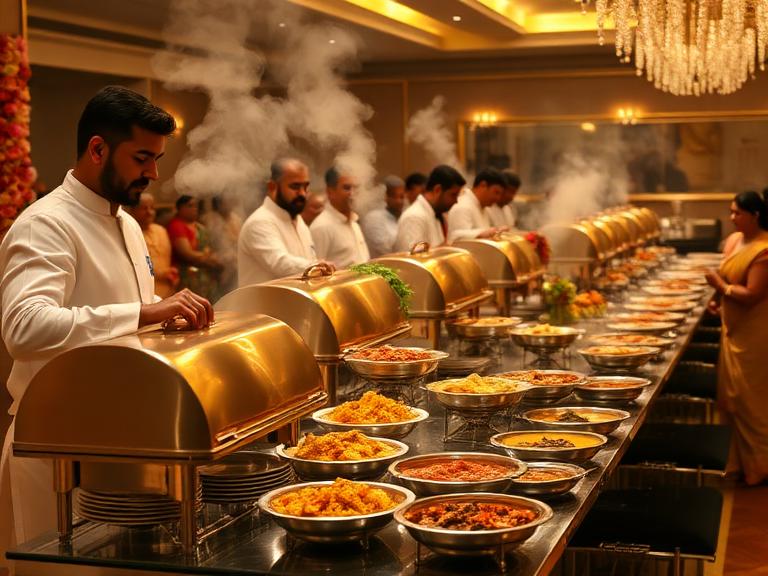
- HITEC City & Gachibowli: Here, “Live Counters” are the rage. Guests love seeing their fish fried fresh or their kebabs charred on a sigree right in front of them. There is also a higher demand for seafood like prawns.
- Secunderabad & Cantonment: A blend of Anglo-Indian and South Indian non-veg styles. You’ll often see cutlets and stews alongside traditional Pulaos.
Guest Volume Patterns and Planning
Non-veg catering requires precision in quantity. Unlike vegetarian food, non-veg dishes—especially mutton—cannot be easily “stretched” at the last minute.
- The “Buffer” Rule: Always maintain a 10% buffer. If you invite 500 people, cater for 550.
- Plate Counting: In Hyderabad, it is standard practice to have a representative from your side stand with the caterer to count the plates. This ensures transparency in billing.
- Wastage Management: Mutton Biryani is heavy. We find that guests often take large portions and waste half. Expert caterers now suggest “Server-Mediated” Biryani stations to manage portion control and reduce waste.
Local Service Logistics: The Operational Reality
Choosing non-veg catering services in Hyderabad involves looking at their logistical “muscles.”
- The “Dum” Timing: A Biryani Deg should be “opened” only 15 minutes before the buffet starts. If it’s opened too early, the rice loses moisture; too late, and the guests are waiting. Ask your caterer about their “Deg opening” schedule.
- Meat Sourcing: Professional caterers like Vaibhavam Caterers have trusted butchers who provide “Daily Fresh” meat. Frozen meat is a strict “No” in high-end Hyderabad catering.
- Staff Training: Handling non-veg service requires agility. Bones must be cleared quickly, and water glasses must be kept full to counter the spices. Check the server-to-guest ratio (1:20 is ideal).
Local Cost Expectations (2026 Estimates)
Pricing is largely driven by the current market rate of mutton. Here is a realistic breakdown:
| Package Tier | Items Included | Avg. Price (Per Plate) |
| Standard Non-Veg | 1 Starter, Chicken Biryani, 1 Dessert | ₹650 – ₹800 |
| Deluxe Non-Veg | 2 Starters, Mutton Biryani, 2 Desserts | ₹850 – ₹1,100 |
| Grand Wedding | 4 Starters, Marag, Mutton Biryani, 3 Desserts | ₹1,200 – ₹1,800+ |
Note: 5% GST and transportation for locations like Moinabad farmhouses are typically extra.
Frequently Asked Questions (FAQ)
1. Is Mutton Biryani more expensive than Chicken Biryani?
Yes. Mutton prices in Hyderabad are significantly higher and the yield after cooking is lower. Expect a difference of ₹150–₹250 per plate.
2. Do caterers bring their own crockery and cutlery?
Yes, standard packages include melamine or ceramic plates. For premium events, you can request “Bone China” or “Stainless Steel” sets for an extra fee.
3. Can I provide my own meat to the caterer?
Most professional caterers discourage this due to quality control and FSSAI hygiene standards. It’s better to trust their sourcing.
4. What is the minimum guest count for non-veg catering?
Most established services in Hyderabad require a minimum of 100 guests for a buffet setup. For smaller groups, they may offer “Mini-Meal” boxes.
5. How do I ensure the mutton is tender?
This depends on the “age” of the animal and the “Dum” time. Always ask for a tasting session (Dawaat) 15 days before the event to calibrate the spice and tenderness.
6. Do you provide fish and prawns as well?
Yes, but seafood is seasonal. We highly recommend Apollo Fish or Prawn Fry as starters for evening receptions.
7. What happens if the guest count exceeds the plan?
Caterers usually prepare a 10% buffer. If you exceed that, the caterer might serve “backup” items like Veg Pulao or extra Chicken dishes, as Mutton Biryani cannot be made instantly.
8. Is mineral water included in the price?
Usually, it is billed as “Actuals.” You pay for the number of bottles or cans consumed at market price.
Conclusion: Trusting Your Tradition to the Experts
A Hyderabad event without a stellar non-veg spread is like a poem without a soul. It requires a caterer who understands that Biryani is a passion, not just a dish. When you look for non-veg catering services in Hyderabad, you are looking for a partner who respects your budget while honoring the city’s culinary legacy.
At Vaibhavam Caterers, we take pride in our “Dum.” We source the finest ingredients and employ chefs who have mastered the Nizami kitchen over decades.
Ready to plan a menu that your guests will rave about? Contact our planning team today for a customized quote and a tasting session.

Leave a Comment